One of the most common questions I hear from parents: "How do I know if my child has dyslexia?"
The short answer is that you need a formal evaluation to get a diagnosis. But there are patterns you can watch for at home that give you a pretty good idea of whether it's worth pursuing one. And the earlier you catch it, the better the outcomes.
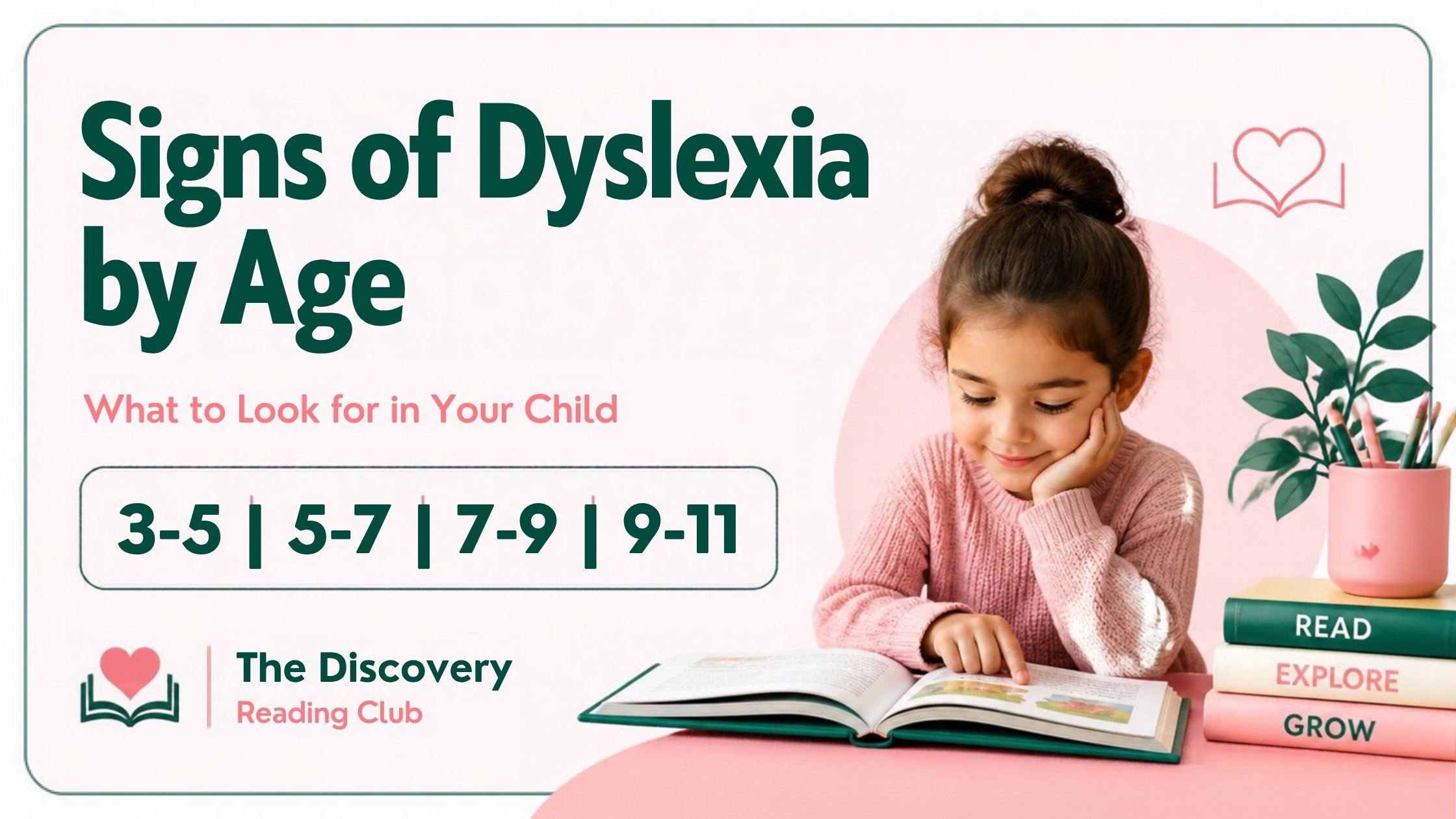
Here's what to look for at each age, based on what the research tells us and what I see in my own practice.
Preschool (ages 3-5)
At this age, you're not looking for reading problems (they're not reading yet). You're looking for the precursors -- the foundational skills that reading is built on.
Watch for:
Difficulty rhyming. Most kids this age love rhyming games ("cat, bat, hat!"). A child who consistently can't produce rhymes or identify when words rhyme is showing a possible early sign.
Trouble learning the names of letters. Not just mixing up a few -- most kids do that -- but persistent difficulty remembering letter names even after repeated exposure.
Difficulty learning the sounds letters make. This is different from letter names. A child might know the letter is called "B" but not connect it to the /b/ sound.
Late talking or mixing up sounds in words. Saying "aminal" for "animal" or "pasghetti" for "spaghetti" past the age when most kids grow out of it (around 4-5).
Difficulty with sequences. Trouble remembering the days of the week, counting in order, or following multi-step directions.
Family history. Dyslexia runs in families. If a parent, sibling, aunt, uncle, or grandparent struggled with reading, the odds go up significantly.
What to do: If you're seeing several of these, bring it up at your child's next pediatric visit and mention it to their preschool teacher. You don't need a formal evaluation at this age, but awareness matters. Start doing phonemic awareness activities at home -- rhyming games, clapping out syllables, songs that play with sounds.
Kindergarten and First Grade (ages 5-7)
This is when reading instruction begins, and it's when dyslexia most often starts to show. The key signs involve a disconnect between what your child can do in conversation and what they can do with print.
Watch for:
Difficulty learning letter-sound connections. Even after direct instruction, they struggle to remember which sound goes with which letter.
Trouble blending sounds into words. They can say /k/ /a/ /t/ individually, but can't put them together to say "cat."
Relying on pictures and context to guess at words instead of sounding them out. This might look like reading skill because they sometimes get the word right, but it's a compensating strategy, not actual decoding.
Slow, labored reading, even with very simple texts. Other kids in the class are reading smoothly while your child is still sounding out every single word.
Letter reversals (b/d, p/q) that persist. Most kids reverse some letters when they're first learning to write. If it's still happening consistently past mid-first-grade, pay attention.
Spelling that doesn't match their intelligence. A bright, articulate child whose spelling looks random -- leaving out sounds, putting letters in the wrong order, spelling the same word three different ways on one page.
Avoiding reading. Making excuses, crying, saying "I'm stupid" or "I hate reading." Kids know when they're falling behind, and avoidance is often the first visible sign.
What to do: Request a meeting with the teacher. Bring specific observations (not "she's struggling with reading" but "she can't blend three sounds together even though she knows all her letter sounds"). Ask what screening has been done. Ask about intervention. If you're not getting satisfactory answers, request a formal evaluation in writing. You have the right to do this under IDEA.
Second and Third Grade (ages 7-9)
By this age, most kids have moved from "learning to read" to "reading to learn." Kids with dyslexia are still stuck on the first part. The gap between them and their peers becomes more visible.
Watch for:
Reading that's significantly below grade level. Not a little behind -- noticeably behind. Other kids are reading chapter books while your child is still working through early readers.
Very slow reading speed. They can decode words, but it takes so long that they lose the meaning. They might read a whole page and not be able to tell you what it said.
Inconsistent word recognition. They'll read a word correctly on one line and not recognize it two lines later. This is because they're not storing words automatically; they're re-decoding every time.
Difficulty with multisyllabic words. They freeze up when they see a long word. They might try to guess from the first syllable or skip the word entirely.
Poor spelling that follows a pattern. They're not spelling randomly -- there's a logic to their errors. They might write "sed" for "said" or "wuz" for "was." These are phonetically reasonable guesses from a child who's trying to use sounds but doesn't know the spelling patterns.
Oral language that's much stronger than written language. Your child can tell a brilliant, detailed story out loud but can't write more than a few choppy sentences. This gap is a hallmark of dyslexia.
What to do: If your child hasn't been evaluated, now is the time. The research is extremely clear that early intervention produces the best outcomes, and by third grade, you want systems in place. Get a formal evaluation through the school or privately, seek out a tutor trained in Orton-Gillingham or structured literacy, and start using structured reading activities at home.
Fourth and Fifth Grade (ages 9-11)
At this age, dyslexia often looks different than it did in earlier grades. Many older kids have developed coping strategies that mask the underlying difficulty.
Watch for:
Avoidance strategies that look like behavior problems. Refusing to read aloud. "Forgetting" assignments. Taking forever on homework. Class clown behavior that distracts from academic struggles.
Heavy reliance on audiobooks, videos, and verbal explanations. If your child can ace a test when the questions are read aloud but fails when they have to read them independently, that's a significant clue.
Exhaustion after school. Reading with dyslexia requires enormous cognitive effort. A child who comes home depleted every day may be spending all their energy just keeping up.
Strong verbal reasoning with weak reading and writing. Dyslexia affects decoding, not intelligence. Many dyslexic kids are creative, perceptive, and verbally gifted. The disconnect between what they can do verbally and what they can do on paper is the pattern to watch for.
Test anxiety or school refusal. These often develop as secondary effects of years of struggling without adequate support.
What to do: It's not too late. Intervention works at every age, though it typically takes longer the later it starts. Get an evaluation if you don't have one. Find a tutor trained in structured literacy. And critically: talk to your child about what's happening. By this age, they've been comparing themselves to their peers for years. They need to understand that their brain works differently, not defectively.
What all of these have in common
Across every age group, the thread is the same: dyslexia is a difficulty with the sound structure of language that makes it hard to connect sounds to letters and decode printed words. It's not about intelligence, effort, or how much a child reads. It's about how their brain processes the code.
The good news is that we know exactly what to do about it. Systematic, explicit, multisensory instruction in how the code works -- structured literacy and Orton-Gillingham approaches -- produces real, measurable progress. The research has been clear on this for decades.
Free resources to get started
I put together a free downloadable guide called "Getting Started with Structured Literacy at Home" that covers the basics of what to do and how to do it.
And if you want to try some structured literacy activities with your child right now, I have a free membership tier at The Discovery Reading Club. No credit card, no strings. Just games, printables, and activities built on OG principles that you can start using today.
Talk soon,
Candace