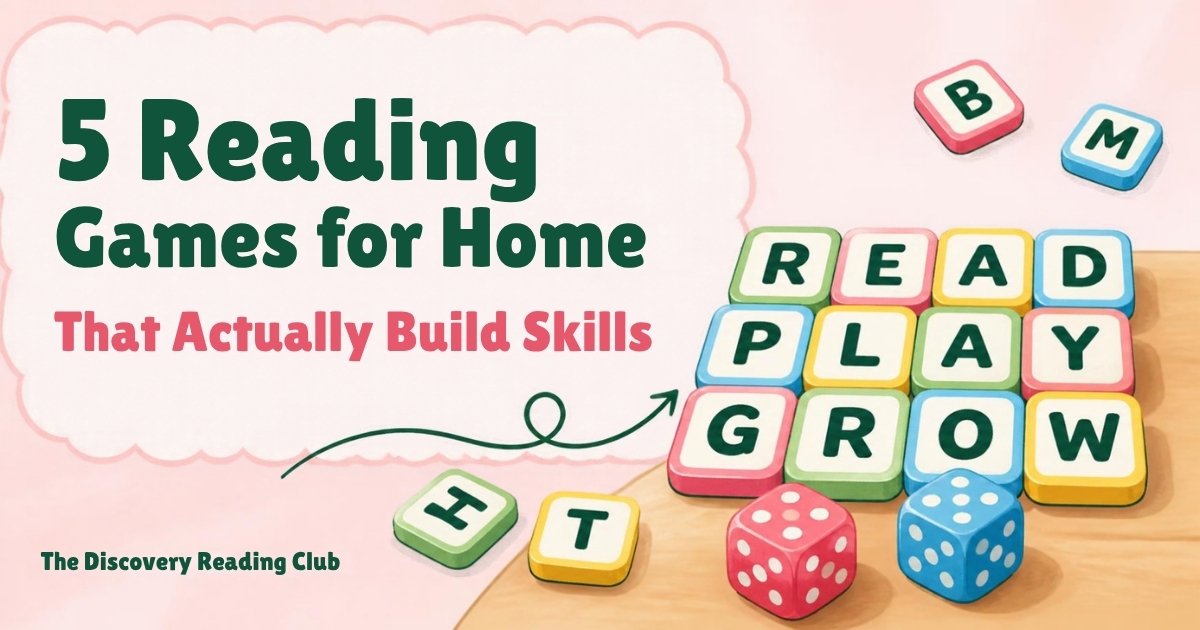
When your child struggles with reading, the last thing you want to do is make it feel like more school. But you know they need practice. So how do you get them to work on reading skills without turning your living room into a battlefield?
You play games.
Not "educational games" that are really just worksheets with a cartoon character on top. Actual games that kids want to play, that happen to be built around the skills they need to develop. I use games like these in my tutoring sessions every week, and kids have no idea they're doing targeted reading work. They just know they're having fun.
Here are five you can try at home with materials you probably already have.
1. Tap and Spell
Skill it builds: Phonemic segmentation (breaking words into individual sounds)
Best for: Ages 5-8, kids working on phonics and early spelling
What you need: Nothing. Just your voice and your child's arm.
Say a word out loud. Start with simple three-sound words like "cat," "sun," or "map." Your child taps their arm once for each sound they hear (not each letter, each sound). Then they spell the word out, connecting each tap to the letter or letters that make that sound.
Why it works: Before a child can read or spell, they need to be able to hear the individual sounds in words. This is phonemic awareness, and it's the single biggest predictor of reading success. Tapping makes an invisible skill (hearing sounds) into something physical, which helps the brain lock it in.
Level it up: Move to four- and five-sound words. Try words with digraphs (like "ship" or "chat") where two letters make one sound. See if your child can identify that the "sh" is one tap, not two.
2. Sound Swap
Skill it builds: Phoneme manipulation (changing individual sounds in words)
Best for: Ages 5-9, once kids can segment sounds
What you need: Nothing, or letter tiles/magnetic letters if you want a visual
Start with a word: "cat." Ask your child to change the first sound to make a new word. "What word do you get if you change the /k/ to /b/?" (bat). Then change the ending sound. Then the middle. Go back and forth.
Why it works: Phoneme manipulation is the most advanced phonemic awareness skill, and it's the bridge between hearing sounds and actually reading. A child who can mentally swap sounds in words is building the flexibility they need to decode new words on the fly. For kids with dyslexia, this skill often needs direct, repeated practice, and turning it into a game makes that practice sustainable.
Level it up: Use letter tiles so your child can physically swap the letters as they swap the sounds. This adds a visual and tactile layer, which is the multisensory approach that OG methods are built on.
3. Read and Roll
Skill it builds: Fluency (reading smoothly, with expression and appropriate speed)
Best for: Ages 6-10, kids who can decode but read slowly or robotically
What you need: A die and a short passage at your child's reading level (a page from a book, a poem, a paragraph you print out)
Your child reads the passage out loud. Then they roll the die, and the number tells them how to read it again:
1 = Read it like a robot
2 = Read it like you're telling a secret
3 = Read it like you're a news reporter
4 = Read it like you're very excited
5 = Read it like you're singing
6 = Read it like you're reading to a baby
Why it works: Fluency comes from repeated reading of the same text, but asking a kid to read something five times is boring. Changing the voice each time makes re-reading fun, and it also forces them to pay attention to expression, pacing, and meaning. After five or six reads, they're reading that passage fluently without even realizing they practiced.
Important: The passage needs to be at their independent level, meaning they can read at least 95% of the words correctly. If they're stumbling on every other word, fluency practice won't help. Decode first, then build fluency.
4. Word Detective
Skill it builds: Vocabulary and morphology (understanding word parts and meanings)
Best for: Ages 7-11, kids who decode fine but struggle with comprehension
What you need: A book you're reading together, plus a notebook or sticky notes
While you read together, your child is a "word detective." Their job is to spot words they don't know, or words that have interesting parts. When they find one, stop and investigate. Break the word into parts. Does it have a prefix? A suffix? A root you recognize?
For example: "unhappiness." Un- means not. Happy is the root. -ness turns it into a noun. So "unhappiness" means "the state of not being happy." Your child just decoded a three-syllable word by understanding its parts.
Why it works: English is not a random language. It's built from roots, prefixes, and suffixes that combine in predictable ways. Teaching kids to see these patterns gives them a tool for figuring out thousands of words they've never seen before. It's also a core component of structured literacy, and it's one of the most powerful comprehension strategies for older struggling readers.
Keep a detective notebook: Write down every word they investigate. After a few weeks, they'll have a collection of word parts they recognize instantly. This is building morphological awareness, and it's a game-changer for reading comprehension.
5. Syllable Basketball
Skill it builds: Syllable awareness and decoding multisyllabic words
Best for: Ages 6-10, kids who freeze up when they see a long word
What you need: A ball (any ball), and a list of multisyllabic words
Say a word. Your child bounces the ball once for each syllable. "Elephant" = three bounces. "Refrigerator" = five bounces. Start with compound words (words where each syllable is a word they know: "cupcake," "sunshine," "basketball"), then move to longer words.
Why it works: One of the most common struggles for kids with dyslexia is seeing a long word and shutting down. They don't know where to start. Syllable awareness teaches them that every long word is just a bunch of short pieces, and if you can read each piece, you can read the whole word. The ball-bouncing makes it physical and rhythmic, which helps the brain internalize the pattern.
Level it up: Write the words on cards. After bouncing out the syllables, have your child draw slash marks between the syllables on the card. Then read each syllable separately, then blend them together. This is the exact strategy they'll use when they encounter an unfamiliar word in a book.
The pattern behind all of these
You might have noticed something these games have in common: they're all multisensory. Tapping, bouncing, swapping, moving. That's not an accident. The research behind Orton-Gillingham and structured literacy shows that engaging multiple senses at the same time helps the brain build stronger reading connections, especially for kids with dyslexia.
These five games are part of a larger library of reading resources I've built at The Discovery Reading Club. If your child responded well to any of these, there are more where they came from.
Explore free reading resources >>
And if you want to go deeper, paid members get access to the full library: 19 games, 40+ printables, and 31 hands-on activities, all built on the same structured literacy principles.
Talk soon,
Candace